

Hallways are often treated like pass-through zones, but they do a lot of work. They carry shoes, school bags, pets, visitors, daily traffic and, in plenty of Melbourne homes, a fair bit of winter mud as well.
A well-chosen hallway runner can completely change how that space feels. It adds warmth, softens sound, protects flooring and turns a narrow corridor into something that looks intentional rather than empty.
This guide explains how runner rugs transform entrances and hallways, how to size them properly and what to check before ordering, including door clearance, underlay and custom overlocking. If you are browsing while you read, explore our range of hall runners.
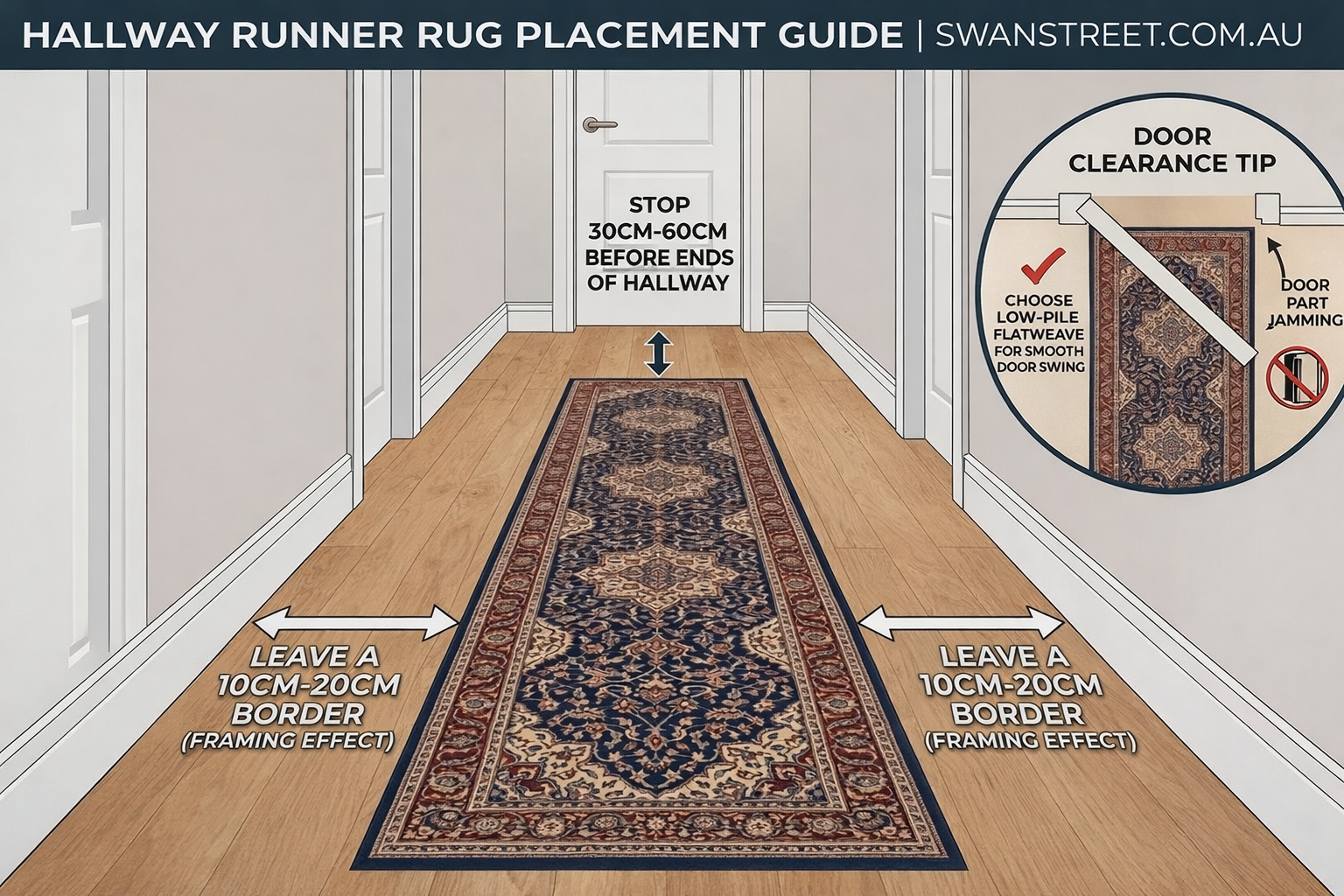
Quick Comparison: Hallway Runner Fit Checks
If you want the fast version, a good hallway runner needs the right width, the right end gap, suitable pile height and proper grip underneath.
| Runner Check | What to Aim For | Why It Matters |
|---|---|---|
| Side border | Roughly 10cm to 20cm of visible floor each side | Frames the runner and stops it looking like fitted carpet. |
| End gap | Leave a small gap at the start and end of the hallway | Makes the runner feel deliberate rather than jammed in. |
| Door clearance | Check every door that swings across the runner | Older Melbourne doors can sit low and catch on thicker rugs. |
| Material | Low-pile wool, flatweave or practical synthetic runners | Hallways take heavy daily traffic, shoes, pets and dirt. |
| Underlay | Use non-slip underlay on timber, tile or laminate floors | Helps reduce movement and protects the floor underneath. |
Placement rule
Leave roughly 10cm to 20cm of flooring visible on each side of the runner. That border makes it look intentional rather than like fitted carpet.
Why Hallway Runners Work So Well
Hallways tend to have hard surfaces, narrow proportions and more foot traffic than almost any other part of the home. Because of this, they can feel cold, echo-prone and visually empty.
A runner solves several problems at once. It introduces warmth and texture underfoot while also protecting flooring from daily wear.
- Softens footsteps and reduces echo.
- Protects timber, laminate or tile flooring.
- Visually lengthens the hallway.
- Makes the entrance feel styled rather than forgotten.
Even a simple runner can dramatically improve how a corridor looks and feels.
5 Ways a Runner Can Elevate Your Entrance
1. A Runner Instantly Warms Up a Narrow Hallway
Long corridors often feel cold or empty, especially when they are lined with timber flooring or tiles. Adding a runner introduces texture and warmth that visually balances the space.
This works particularly well in older Melbourne terraces where hallways can be long and narrow. Instead of feeling like a corridor, the space starts to feel like a designed part of the home.
2. Runners Visually Lengthen the Space
Because runners follow the natural direction of the hallway, they guide the eye forward through the space.
This simple visual trick makes the corridor feel longer and more balanced. Patterned runners work especially well here because they naturally draw attention through the length of the hallway.
3. They Protect High-Traffic Flooring
Hallways experience constant daily traffic, which can gradually wear down timber, laminate or tile floors.
A runner absorbs that traffic and protects the surface underneath. This is especially useful in family homes where shoes, pets and everyday movement can quickly leave visible wear patterns on flooring.
4. Runners Reduce Noise and Echo
Hard surfaces bounce sound around, which is why hallways often feel slightly echoey. A runner softens footsteps and helps take some of that sharpness out of the space.
Durable materials like polypropylene are popular for hallway runners because they handle heavy daily traffic well.
5. They Make the Entrance Feel Intentional
The hallway is often the first space people see when they enter a home. A runner gives the space a sense of design and purpose rather than leaving it as an empty stretch of flooring.
If your hallway leads to a staircase, choosing a runner that complements your stair carpet or nearby rugs can help create a more seamless flow through the home.
How to Size a Hallway Runner Properly
The most common mistake people make with runners is choosing the wrong width.
A runner should never sit wall to wall. Instead, it should be framed by visible floor space on both sides. A good rule is to leave roughly 10cm to 20cm of floor visible on each side.
The runner should also stop slightly short of the hallway ends rather than touching the walls. This small border creates the balanced framing effect that makes the runner look intentional.
Common Hallway Runner Sizes
Every hallway is different, but most runner rugs fall into a few practical size ranges. Choosing the right size comes down to the width of the hallway and how much visible floor you want around the edges.
- 60cm to 70cm wide runners work well for narrow hallways or terraces.
- 70cm to 80cm wide runners are common for many standard hallways.
- 80cm to 90cm wide runners suit wider corridors where a narrow runner would look lost.
Length depends on the hallway itself. Many runners range from around 2 metres to 6 metres long, but the key rule is to leave a small gap at each end rather than running wall to wall.
As a guide, many people leave around 30cm of space before the end of the hallway so the runner looks framed rather than squeezed in.
Why Runner Rugs Often Need Overlocking
Many hallway runners are cut from larger carpet rolls rather than manufactured as finished rugs.
When this happens, the edges need to be professionally overlocked so the fibres do not fray or unravel over time. Overlocking neatly stitches the ends of the runner and gives it a clean, durable finish.
If your runner has been cut to size, we offer a professional runner overlocking service to properly finish the edges.
Custom runner tip
If you need a specific length, contact our floor coverings team rather than guessing online. Custom-cut runners usually need overlocking added so the ends are properly finished.
The Melbourne Door Clearance Tip
Many older homes in suburbs like Richmond, Abbotsford, Fitzroy and Carlton have heritage doors that sit quite low to the floor.
Before choosing a thick runner, check that the door will still open freely. If clearance is tight, choose a flatweave or low-pile runner rather than a plush rug.
This avoids the classic door-catching-on-the-rug problem.
If the runner is sitting on timber, tile or laminate flooring, using a non-slip underlay is strongly recommended. Products like Miracle Grip help anchor the runner to the floor so it does not shift with daily foot traffic.
More Rug Buying Guides
If you are still narrowing down size, material, texture, cleaning needs or style, these rug guides will help you make the next decision without guessing.
- Rug Size Guide: How to Measure and Place a Rug in Every Room
- Natural vs Synthetic Rugs: When to Choose Jute, Wool or Polypropylene
- Best Rugs for Kids and Pets: Stain-Resistant, Low-Shed and Washable Options
- How to Clean Rugs at Home Without Damaging Them
- Rug Texture Guide: Flatweave, Shag, Cut Pile and Loop Pile
- Rug Styles Explained: Modern, Traditional, Transitional, Shag, Jute and Outdoor Rugs
Frequently Asked Questions About Hallway Runners
Can I order a custom length hallway runner?
Yes. Many hallway runners can be cut to custom lengths to suit your space. For example, if your hallway needs something like 4.5 metres or 5.2 metres, we can often arrange this.
Our website currently only accepts whole numbers when ordering runners online, so custom lengths cannot be selected through the checkout.
If you need a specific length, please contact our floor coverings team and we can organise the order for you.
Phone: (03) 9428 1746
Email: floorcoverings@swanstreet.com.au
Custom-cut runners will typically require the ends to be professionally finished, so we also provide an overlocking service to give the runner a clean, durable edge.
How wide should a hallway runner be?
Most runners should leave visible flooring on both sides. Aim for roughly 10cm to 20cm of floor space between the runner edge and the wall.
Should a runner go the full length of a hallway?
Not usually. Leaving a small gap at each end helps frame the runner and prevents it from looking like wall-to-wall carpet.
Are runners safe on timber floors?
Yes, but using a non-slip underlay such as Miracle Grip helps prevent movement and protects the floor surface.
What materials work best for hallway runners?
Low-pile wool, flatweave rugs and synthetic materials like polypropylene work particularly well because they handle heavy traffic and are easier to maintain.
Are there washable hallway runners?
Many modern synthetic runners are designed to be easy-clean or machine washable. These are popular in busy homes where mud, pets and Melbourne winter weather are part of daily life.
Prefer to See Runner Sizes in Person?
If you are in Melbourne, visit our Richmond showroom on Swan Street to compare different runner widths and textures in person. Seeing the scale helps a lot, especially in narrow hallways and older homes.
Bring hallway measurements, a few photos and any door clearance concerns with you. We can help you choose the right width, length, texture and underlay before you order.
Browse hall runners Or visit our Richmond showroom at 365 Swan St, Richmond VIC 3121.
Family owned since 1956.