

Office layout sounds like a big-picture decision, but it usually comes down to a few practical questions. Where do people enter? Where do they stop? Where do they sit? Where do they need privacy, and where do they not?
That is why getting the mix of reception desks, meeting tables and partitions right can make an office feel easier to use from day one. These pieces do more than fill space. They help shape how the office works.
A reception desk gives visitors a clear arrival point. A meeting table gives conversations a proper home. A partition helps create separation without needing permanent walls. If you are planning a new workspace or cleaning up one that has grown a bit all over the place, browse our reception desks, meeting tables, partitions and broader office furniture range.
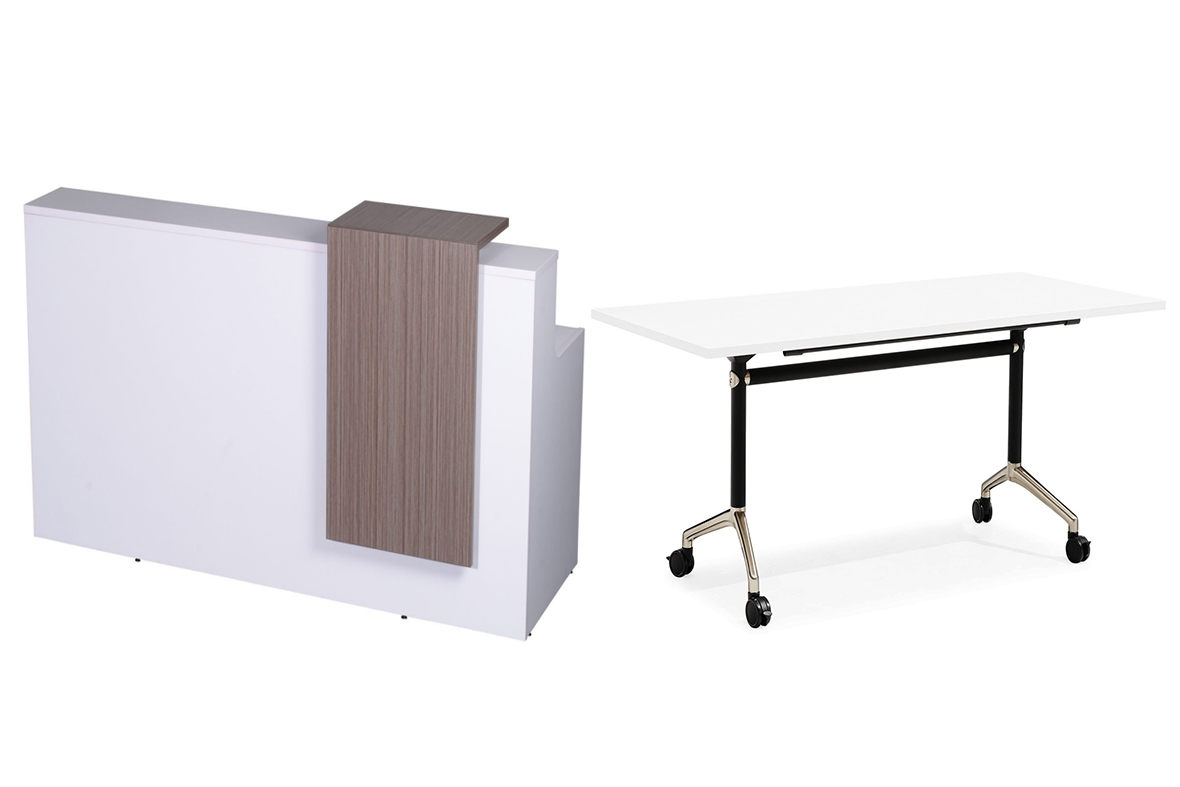
Start with the Flow of the Room
Before picking finishes, look at movement. A practical office layout should make it obvious where to enter, wait, meet and focus. If a room feels confusing or cluttered, the layout, not the furniture, is usually the culprit.
Start by marking the main paths: the front door, reception point, workstations, meeting area, storage and any waiting or visitor seating. Once those paths are clear, it becomes easier to decide what furniture belongs where.
Layout check
A good layout should guide people without a sign. Visitors should know where to go, staff should know where meetings happen, and the room should not feel like every task is fighting for the same corner.
Reception Desks Set the Tone and Anchor the Entry
A reception desk is not just somewhere for a phone and a computer. It is often the first thing people see when they walk in, so it has to do two jobs at once. It needs to work practically for the person using it, and it needs to make the front of the office feel organised and intentional.
In a larger or more open room, a reception desk also acts as an anchor. It gives visitors an obvious point to head towards and helps the front of the office feel structured straight away. Even smaller offices can benefit from a compact reception unit rather than leaving the entry floating.
A good reception desk can help with:
- giving visitors a clear point of contact
- separating front-of-house from the rest of the workspace
- keeping cables, paperwork and daily admin less visible
- making the entry feel more settled and professional
In some offices, the reception desk is a major feature. In others, it is more compact and understated. The right size depends on how much front-desk work actually happens there and how much room the entry has to spare.
Pro tip
A reception desk should guide people naturally, not block the whole entry. If visitors are unsure where to stand or how to approach it, the layout probably needs simplifying.
Meeting Tables Create a Proper Place to Stop and Talk
Without a dedicated meeting surface, offices tend to fall into bad habits. Quick conversations spill into walkways. Staff gather around someone's desk. Visitors end up perched awkwardly in the wrong part of the room.
A meeting table solves that by giving discussions a proper home.
That can mean different things depending on the office:
- a smaller round table for quick chats
- a shared table in an open-plan workspace
- a compact table for interview or consult rooms
- a larger boardroom table for more formal meetings
The point is not just to have a table. It is to create a space that suits the kind of conversations the business actually has.
If most meetings are brief and informal, you may not need a huge boardroom setup. But if you regularly meet with clients, suppliers or staff groups, a boardroom table can make a real difference. It gives those conversations a more settled, professional place to happen and stops meeting overflow taking over day-to-day work areas.
When choosing a meeting table, do not forget the seating around it. In a lot of offices, visitor chairs are the more practical and space-efficient choice for meeting areas.
Partitions Help an Office Feel Calmer Without Fully Closing It Off
Partitions are one of the simplest ways to improve how an office feels without committing to full walls or permanent construction.
They can help define zones, add privacy, reduce visual distraction and make open areas feel more purposeful. That is especially useful in offices where the room needs to do several jobs at once.
A partition can help separate:
- front desk from workstations
- meeting space from general office traffic
- one workstation from another
- a quieter admin area from busier shared space
The benefit is often less about complete privacy and more about making the room feel less exposed. Even a modest divider can make a workspace feel more settled.
| Furniture Type | Best For | What It Helps With |
|---|---|---|
| Reception Desk | Front entry and visitor-facing areas | Check-in, first impressions and front-of-house organisation |
| Meeting Table | Formal or informal discussions | Giving meetings a proper place instead of using work desks |
| Partition | Open-plan and multi-use spaces | Creating separation, privacy and clearer zones |
Small Office Strategy: Create Zones, Not Clutter
In smaller offices, spare-room business setups and compact commercial spaces around Melbourne, one room often has to do a lot. That is where these pieces can work together really well.
A reception desk can define the front. A meeting table can give you somewhere to sit with clients or staff. A partition can stop the whole room feeling like one exposed box.
The trick is to use furniture to create zones without overfilling the room. You still need clear walkways, enough room to pull chairs out comfortably and enough breathing space so the office does not fight back.
It helps to think in tasks, not just furniture types. Ask what each part of the room needs to do every day. Do people need a clear check-in point? Do meetings happen often enough to justify a dedicated table? Does the office need privacy or separation in certain spots?
If desk space is also part of the puzzle, it is worth reading our guide on small space desk ideas.
Small office rule
Create zones, not obstacles. Furniture should make the room easier to understand, not harder to move through.
Not Every Office Needs All Three in the Same Way
Not every workspace needs a full reception fit-out, a large meeting table and multiple partitions all at once.
Some offices need a strong front desk presence and very little else. Some barely need reception at all but rely heavily on meeting space. Others mainly need partitions to make an open room work better.
The practical move is to prioritise the piece that solves the biggest layout problem first.
- Choose a reception desk first if visitors have no clear arrival point.
- Choose a meeting table first if conversations keep hijacking work desks.
- Choose partitions first if the room feels too exposed, distracting or chaotic.
Once that main issue is sorted, the rest of the layout usually becomes easier to plan.
Practical Office Layout Ideas Usually Win Over Perfect-Looking Ones
The best office layouts are not always the most dramatic or polished ones. They are the ones that make daily use feel easier.
If visitors know where to go, staff have somewhere sensible to meet, and the workspace feels organised without being boxed in, you are probably on the right track.
That is really what reception desks, meeting tables and partitions are doing. They help the office make more sense.
Get that part right and the whole space tends to feel more settled, more usable and more professional without trying too hard.
More from Our Office Furniture Guide Series
If you are planning an office fit-out or tightening up a home workspace, these guides cover desks, chairs, storage and layout ideas across the full Office Furniture range.
- Office Furniture Buying Guide for Home Office, School or Workplace
- Small Space Desk Ideas: Student Desks and Office Desks for Compact Rooms
- Sit-Stand Desk vs Fixed Desk: Is It Worth It for Your Setup?
- Visitor Chair vs Desk Chair: What Suits Your Office Better?
- Filing Cabinet vs Mobile Pedestal: Which Office Storage Works Better?
- Office Storage Ideas: Shelves, Cupboards, Cabinets, Hutches and Buffets Explained
Frequently Asked Questions
Do I need a reception desk in a small office?
Not always, but it can make a big difference if visitors, clients or deliveries regularly arrive. Even a compact reception desk can give the front of the office a clearer structure and a proper point of contact.
What size meeting table works best in a small office?
That depends on how the space is used, but smaller round or compact rectangular tables often work well for short meetings and everyday discussions without taking over the room.
Are partitions a good idea in an open office?
Yes, especially if the office feels too exposed or distracting. Partitions can help define zones, add privacy and make the room feel calmer without fully closing it off.
Can reception desks, meeting tables and partitions all work in one room?
Yes, as long as the layout is planned properly. In smaller offices, the trick is choosing pieces that define the space without overcrowding it.
What is the best way to improve an office layout without renovating?
Using the right furniture is often the easiest place to start. A reception desk can define the entry, a meeting table can stop conversations spilling into work areas, and partitions can create clearer zones without full construction work.
Choose Office Layout Furniture That Makes the Room Work
The right office layout furniture does not just fill a room. It gives the entry a clear point, meetings a proper place and shared work areas enough separation to feel calmer.
If you are planning a reception area, meeting space, compact office or shared workplace, bring your measurements, photos and rough layout into our Richmond showroom. We can help you compare reception desks, meeting tables, partitions and broader office furniture before you order.
Browse office furniture Or visit our Richmond showroom at 365 Swan St, Richmond VIC 3121.
Family owned since 1956.