

If you are toilet shopping and keep seeing S-trap, P-trap, skew trap or universal toilet suite, this is the part that decides whether the new pan will actually fit your bathroom. The styling can wait. The plumbing match is the bit that matters first.
A lot of ordering mistakes happen because people identify the trap type, feel confident, and stop there. Then set-out gets missed, the inlet position gets ignored, or a skew outlet turns out to be on the opposite side. This guide cuts through that properly, so you can work out what you have, what to measure, and what matters before you order anything.
When you are ready to browse, you can see our wider range of toilets here.
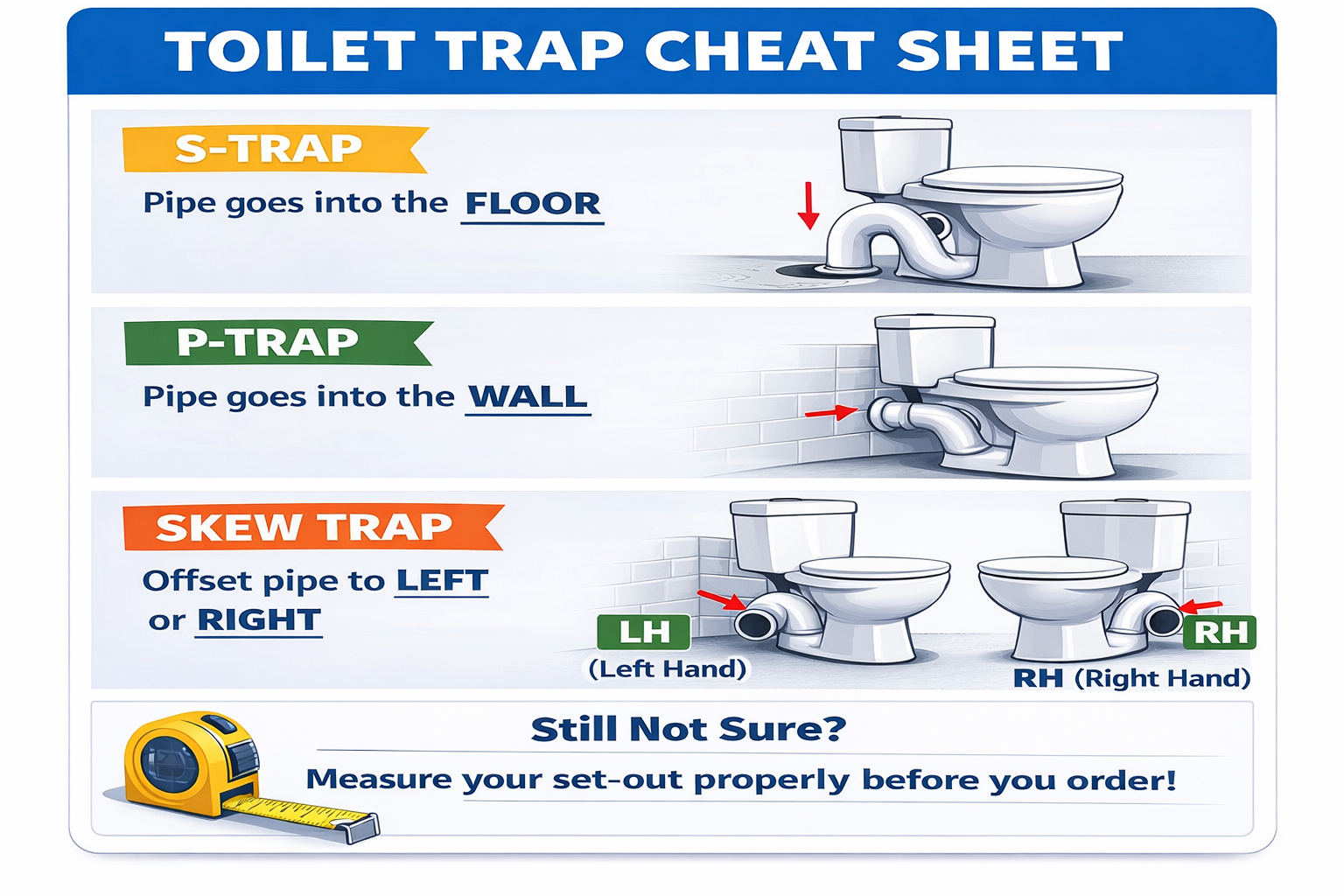
The 10-second difference
S-trap
The waste outlet goes down into the floor. In most cases, you will see the connection disappearing into the tiles beneath the toilet rather than heading into the wall behind it.
P-trap
The waste outlet goes back into the wall. This is the setup where the outlet height from the finished floor becomes especially important, because that wall position has to line up with the new suite properly.
Skew trap
The outlet is offset to one side rather than centred. This usually comes up in older or awkward plumbing layouts, and if it does, you normally need to confirm whether it is left-hand or right-hand as you face the toilet.
Why trap type is only step one
Knowing whether you have an S-trap, P-trap or skew trap is important, but it is only the first checkpoint. Toilets are not just defined by where the waste exits. They are also shaped by set-out, inlet position, connector requirements, and the amount of room the pan projects into the bathroom.
This is where a lot of people get caught. They match "floor waste to floor waste" or "wall waste to wall waste" and assume the rest will sort itself out. Sometimes it does. Sometimes it absolutely does not. One missed measurement can turn a simple swap into a frustrating reorder.
- Set-out: tells you where the outlet centre sits in relation to the finished wall or floor.
- Inlet position: matters because not every suite suits the same water entry point.
- Skew direction: if the outlet is offset, left-hand and right-hand are not interchangeable.
- Pan projection: a new toilet can fit the waste but still sit further into the room than your old one.
What a universal trap toilet actually means
A lot of modern suites are sold as universal trap or uni-trap. That usually means the same toilet can be configured for either S-trap or P-trap installation, often with the help of a connector or Vario bend.
That flexibility is useful, but it does not mean the toilet fits every bathroom by magic. You still need to confirm the measurement range it suits, check the inlet position, and make sure the overall pan shape and projection work in your space.
In other words, universal does not mean universal in the everyday sense. It usually means more adaptable, not foolproof.
How to measure set-out properly
This is the detail people mix up most often, especially when switching from one brand to another.
S-trap set-out
Measure horizontally from the finished wall to the centre of the floor waste.
P-trap set-out
Measure vertically from the finished floor to the centre of the wall waste.
Always measure from finished surfaces like tiles, not bare framing, bare slab or unlined wall positions. In a renovation, that difference can be enough to throw the install off.
Before ordering, it is also smart to confirm the water inlet position and whether the toilet relies on a specific connector. Those details are less glamorous than the toilet finish, but a lot more important on delivery day.
When skew traps come into play
Skew trap toilets usually enter the conversation when the outlet is not centred where a standard S-trap or P-trap pan expects it to be. That can happen in older homes, awkward renovation layouts, or bathrooms where the waste had to dodge around a joist or some other site limitation.
If you suspect skew, do not stop at "it looks offset". Confirm whether it is left-hand or right-hand as you face the toilet. That one detail matters, because getting it backwards is an easy way to order the wrong suite.
- Older toilet replacement: older plumbing layouts are often where skew shows up.
- Offset waste position: the outlet sits noticeably left or right, not neatly centred.
- Awkward room layout: sometimes the waste location was a compromise from the start.
Quick comparison table
| Trap type | Outlet location | What to measure | Common scenario |
|---|---|---|---|
| S-trap | Through the floor | Finished wall to centre of floor waste | Common in many Australian homes |
| P-trap | Into the wall | Finished floor to centre of wall waste | Often seen in apartments and some newer builds |
| Skew trap | Offset left or right | Confirm LH or RH offset and exact position | Older or awkward plumbing layouts |
| Universal trap | Can suit more than one setup | Still needs set-out and inlet confirmed | Flexible modern toilet suites |
Replacing vs renovating
If you are replacing an existing toilet
Match the current setup first, then check the measurements properly.
- S-trap should replace S-trap unless plumbing is being changed
- P-trap should replace P-trap unless plumbing is being changed
- Skew should be matched with the correct left-hand or right-hand orientation confirmed
- Set-out, inlet position and projection should still be checked before buying
If you are renovating
You have more flexibility, but that also means more room to get it wrong if the finished dimensions are guessed too early.
- Decide whether the waste will run into the floor or wall
- Allow for finished wall and floor thickness
- Confirm inlet position before locking in the toilet
- Check that the pan shape and projection suit the room layout
This is the stage where it pays to be boring and precise. A neat plan beats a stylish guess every time.
Common mistakes before ordering
- Assuming all floor waste toilets are interchangeable
- Checking trap type but skipping the set-out measurement
- Forgetting to confirm inlet position
- Ordering a skew trap without confirming LH or RH properly
- Focusing only on the waste and forgetting overall toilet projection
Most toilet ordering dramas are not caused by exotic plumbing problems. They are usually caused by one simple detail being assumed instead of checked.
The simple version
If the waste goes into the floor, you are in S-trap territory. If it goes into the wall, you are in P-trap territory. If it is offset to one side, skew may be involved. From there, the real work is measuring properly and checking the finer details before ordering.
If you are browsing toilets now, start with the right trap type, then confirm set-out, inlet position and room fit before falling in love with the look of a suite. That is the order that saves headaches.
You can browse our full range of toilets here once you are ready.
Frequently Asked Questions
What is the difference between an S-trap and a P-trap toilet?
An S-trap toilet discharges through the floor, while a P-trap toilet discharges through the wall. That one difference changes both the toilet choice and the way you measure before ordering.
How do I measure toilet set-out properly?
For an S-trap toilet, measure from the finished wall to the centre of the floor waste. For a P-trap toilet, measure from the finished floor to the centre of the wall waste. Always measure from finished surfaces.
What is a skew trap toilet?
A skew trap toilet suits an outlet that is offset to the left or right rather than centred. If skew is involved, confirm whether it is left-hand or right-hand as you face the toilet.
Will a universal trap toilet fit any bathroom?
No. A universal trap toilet can often cover more than one installation type, but you still need to confirm set-out, inlet position and physical fit.
Do I need to check inlet position as well as trap type?
Yes. Trap type tells you where the waste goes. It does not automatically confirm that the water inlet location suits the suite you are buying.
How do I know if I need a left-hand or right-hand skew trap?
Check which side the outlet offsets to as you face the toilet. If it offsets left, it is left-hand skew. If it offsets right, it is right-hand skew.
Can I just match my old toilet and assume the new one will fit?
Not safely. Even if the trap type matches, the new suite can still differ in set-out tolerance, inlet position, connector needs and overall projection into the room.
More Toilet Buying Guides
If you are still working through the right toilet setup, these guides cover the other decisions that usually come up before ordering.
- Toilet Buying Guide Australia
- How to Measure Toilet Set-Out
- Toilet Seat Replacement Guide
- Replacing a Toilet Without Moving Plumbing
- Back-to-Wall vs Close Coupled vs Wall-Hung Toilets
Need Help Checking Trap Type?
If you are not fully sure whether you have S-trap, P-trap or skew, or you want a second set of eyes on your measurements before ordering, get in touch with us or visit our Richmond showroom. A quick check now is a lot easier than fixing the wrong toilet later.
Visit our Richmond showroom 365 Swan St, Richmond VIC 3121. No appointment needed.