

Long-form outdoor furniture guide · Written by the team at Swan Street Sales, Richmond
The right outdoor furniture is not simply the biggest setting that will fit on the deck, the nicest timber colour in a photo or the chair that feels comfortable for thirty seconds in a showroom. A balcony, courtyard, covered patio and large backyard all ask different things of the furniture you put into them.
Before choosing the style, start with the way the space is actually used. How many people sit there most weeks? How many arrive when friends or family come over? Is the area mainly for meals, drinks, barbecues, morning coffee or a mixture of everything? Does the furniture stay in one position all year, or does it need to move regularly?
Outdoor furniture also has to deal with something indoor furniture does not: exposure. Sun, rain, moisture, dirt, leaves and long periods between uses all influence what makes sense. In Melbourne, a setting bought for summer still needs to make sense through the rest of the year.
Residential and commercial outdoor furniture often overlap more than people expect. A substantial timber and galvanised steel table can be equally comfortable in a beer garden, on a family deck or under a covered entertaining area. Change the seating around it and the same table can take on a completely different character.
If you are shopping now, browse our outdoor furniture range. This guide is designed to help you work out what type of setting, table and seating arrangement makes sense before you get too far into colour, style or individual products.
The short version is simple: measure the space first, decide how you actually use it second, and choose the furniture third. The best outdoor setting is the one that seats the right people without making the rest of the area harder to use.
.png)
The Short Answer
The best outdoor furniture is furniture that suits the space when it is actually being used. That sounds obvious, but it is where many buying mistakes start. A table can fit neatly when every chair is tucked underneath it and still be far too large once people are sitting down, doors are opening and someone is trying to walk past carrying dinner.
Start with four things: the usable area, the normal number of people, the maximum number you realistically entertain and how exposed the location is. Those four answers will usually narrow the furniture down faster than starting with colour or style.
Simple rule: measure the space first. Choose how you use it second. Choose the furniture third.
- Small balcony: prioritise footprint and clear movement.
- Courtyard: balance dining capacity with access around the setting.
- Deck or patio: think about occupied chairs, serving space and how people enter and leave the area.
- Large entertaining area: long tables and bench seating can make excellent use of the available space.
- Exposed outdoor area: material choice, care and weight become more important.
Practical tip
“Do not measure whether the table fits. Measure whether the table, occupied chairs and the people walking around it fit.”
If you get the footprint and use right first, the rest becomes much easier. You can then decide whether a complete setting, separate table and chairs, a bench configuration or a higher bar-style setup makes the most sense.
Start with the Space, Not the Furniture
A compact apartment balcony and a large family deck may both need outdoor furniture, but they are not the same buying problem. The first may need two chairs and a compact table that leaves the doorway clear. The second might need to seat eight people most weekends and twelve when the family turns up.
This is the part worth solving before browsing individual settings. People naturally look at a table or chair and imagine it in the space. The better approach is to think about what actually happens outside first, then choose furniture around that.
How Will You Actually Use the Area?
Outdoor areas tend to fall into a few broad uses, and many homes combine several of them:
- everyday family dining
- weekend barbecues and larger gatherings
- morning coffee or casual drinks
- small-space balcony dining
- kids eating or playing outside
- workplace lunches or shared staff areas
- commercial or community entertaining
A family that eats outside three nights a week should make a different decision from somebody who mainly needs two seats for coffee. Likewise, a household that entertains ten people regularly may get more value from a long communal table than from a conventional four-person outdoor setting.
Questions to Ask Before Choosing Outdoor Furniture
- How large is the usable area? Measure the space people can actually occupy, not just the overall deck or courtyard dimensions.
- How many people normally sit there? Buy primarily for normal use rather than a once-a-year gathering.
- What is the realistic maximum? If friends and family regularly push the number higher, plan some flexible seating into the layout.
- Is the area mainly for dining or casual use? Table height, chair style and overall footprint change with the job.
- Is it covered? Exposure can affect material and maintenance choices.
- Does the furniture need to move? Weight is an advantage in some outdoor settings and a nuisance in others.
- Where are the doors, stairs, barbecue and walkways? These need to remain usable when everyone is seated.
- Will you need shade? Plan an umbrella or other shade solution before the furniture fills the available area.
What we would ask in-store: Is this a balcony, courtyard, deck or backyard? How many people use it most of the time? Do you want separate chairs or communal benches? Does the furniture live outside permanently? Is there already an umbrella or covered area? Those answers are usually more useful than starting with “I want something about two metres long.”
Practical tip
“Tell us what happens outside before telling us what colour table you are looking for.”
Outdoor Furniture by Space and Use
There is no single best type of outdoor furniture because the job changes with the space. A useful first step is matching the furniture direction to the way the area behaves in real life.
| Outdoor Situation | What Usually Matters | Furniture Direction | Watch Out For |
|---|---|---|---|
| Apartment balcony | Compact footprint and easy movement. | Small two-to-four person setting or compact table and chairs. | Overcrowding and blocking the doorway. |
| Courtyard | Dining capacity plus circulation. | Compact setting or flexible separate table and chairs. | Using every square centimetre for furniture and leaving nowhere to move. |
| Deck or patio | Dining, entertaining and access around the table. | Dining table with individual chairs, benches or a mixture of both. | Forgetting the space chairs occupy when pulled out. |
| BBQ / entertaining area | Casual group seating and easy movement. | Long table, bench setting or flexible communal layout. | Blocking access to the barbecue, kitchen or serving area. |
| Large backyard | Group entertaining and defined outdoor zones. | Larger dining or communal table with additional seating and shade. | Spreading furniture around without creating a usable dining zone. |
| Pub, club, workplace or shared area | Durability, capacity and repeated use. | Heavy-duty tables, benches and commercial-style seating. | Choosing light domestic furniture for genuinely heavy use. |
This is not about forcing every outdoor area into one answer. It is simply a way to point the decision in the right direction. The easiest shortcut is to describe the busiest version of the space, not the quietest one.
Complete Outdoor Setting or Separate Pieces?
A complete setting is convenient, but it is not automatically the best answer. You can choose a complete outdoor setting or build the space around a separate outdoor table, chairs and benches.
Complete Outdoor Setting
A complete setting is the simplest option when you want the table and seating already proportioned as a group. It is useful for buyers who want the whole area resolved at once rather than building the combination piece by piece.
It can also make sense when the setting itself is part of the look. A matching timber table and bench arrangement has a strong communal character, while a compact three-piece setting is more naturally suited to a small balcony or courtyard.
Separate Table and Chairs
Separate pieces give you more control. You may already own chairs you want to keep, need a different number of seats from the standard setting, or simply prefer individual chairs around a heavy-duty table.
This is particularly useful with long outdoor tables. A table that looks like traditional beer garden furniture when paired with two benches can feel completely different when surrounded by individual dining chairs.
Table and Bench Setting
Bench seating deserves more consideration than it often gets in residential outdoor areas. It can seat groups efficiently, keeps the layout visually simple and suits the relaxed way many people actually use decks, patios and barbecue areas.
It also works well when the outdoor area regularly changes from family use to larger gatherings. People tend to share bench space more flexibly than a fixed number of individual chairs.
Heavy-Duty Outdoor Tables: Not Just for Beer Gardens
Timber-topped, galvanised-frame tables are commonly associated with beer gardens and hospitality venues. Calling them “beer garden tables” is useful because people immediately understand the style, but it can also make this type of furniture sound more specialised than it really is.
A good heavy-duty outdoor table is simply a substantial table designed for serious use. That can be exactly what a family deck, covered patio, backyard entertaining area, workplace or holiday property needs.
Built for Hospitality, Equally Useful at Home
The same qualities that make a table useful in a venue can make it useful at home: a substantial frame, a generous top, simple construction and the ability to seat a group without feeling precious.
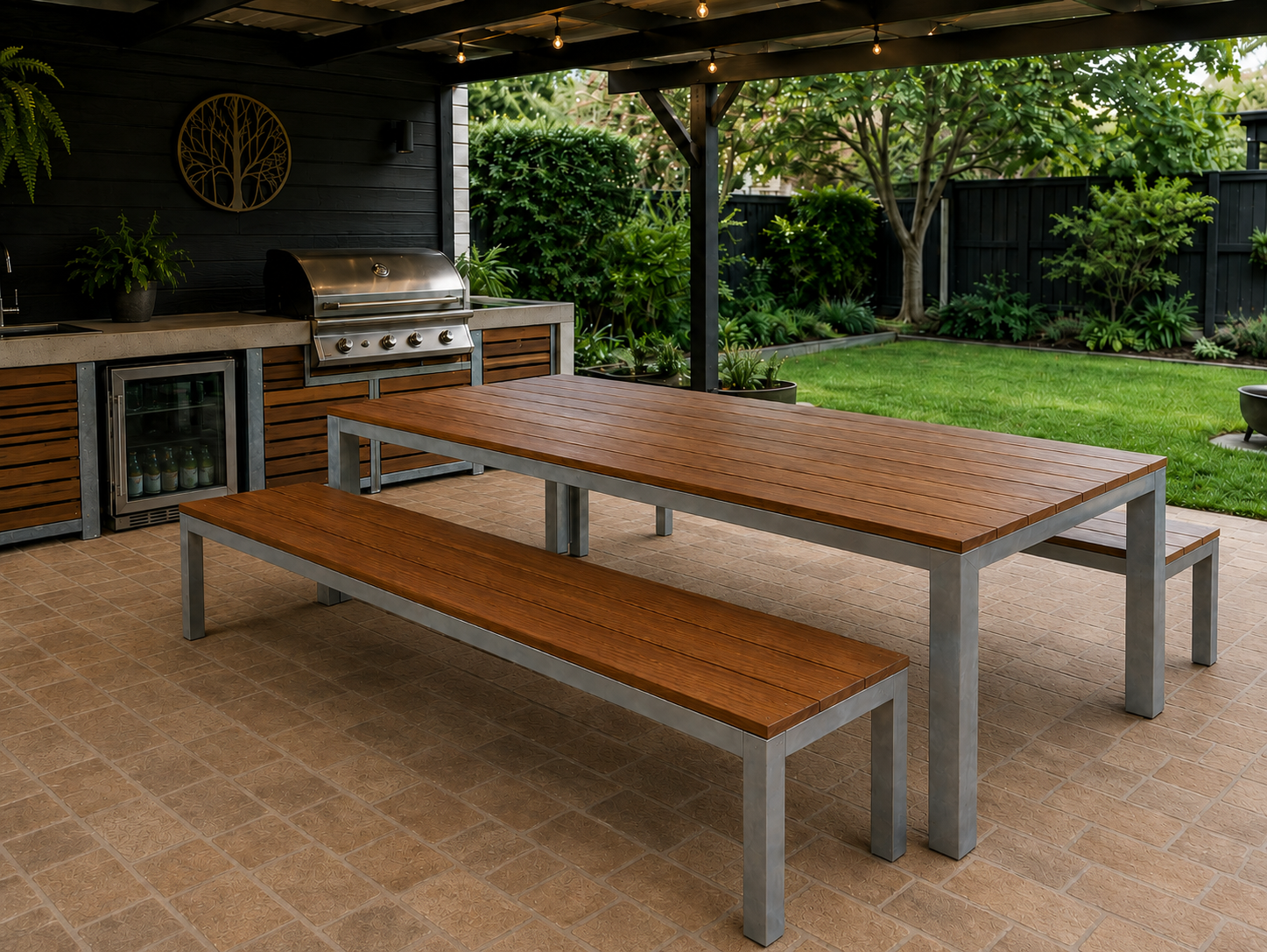
That does not mean every home should look like a pub courtyard. The seating changes the character enormously. Pair a long galvanised timber table with matching benches and the communal beer garden character is obvious. Pair the same table with individual outdoor chairs and it becomes a substantial residential dining table.
Pairing a Long Table with Individual Chairs
This is a combination we have seen work extremely well. Individual chairs give every person their own seat, are easier to move independently and can make a large heavy-duty table feel more like a conventional outdoor dining setting.
The 2400 mm galvanised timber table pictured in this guide was installed on a residential timber deck in 2020 and paired with individual Robert outdoor chairs. It is a good example of why the commercial/residential divide is not always useful when choosing outdoor furniture. The table is substantial; the overall setting still reads as a home dining area.
Pairing the Same Table with Benches
Swap the chairs for benches and the same basic table becomes more communal. That makes sense for family gatherings, barbecues, shared meals and areas where fitting plenty of people around one table matters more than giving every person a separate chair.
Table-and-bench settings are available in a range of useful lengths, including compact 1200 mm formats through to much larger 2400 mm arrangements. The right size is not just about how many people could theoretically fit along the table; it is about the area available around it once those people are actually seated.
Bar-Height Outdoor Tables
Bar-height outdoor tables suit a different kind of area. They can work well for casual drinks, standing-and-seated entertaining, hospitality spaces or an outdoor zone where people move in and out rather than sitting down for a long meal.
If you are looking at that direction, our small outdoor stool range can be considered alongside bar-height tables. It is not a huge category, but it serves a specific job.
| Configuration | Best Suited To | Main Advantage | Consider |
|---|---|---|---|
| Table + individual chairs | Residential dining and flexible seating. | Individual comfort and easy chair movement. | Allow enough space behind every occupied chair. |
| Table + benches | Family gatherings and communal entertaining. | Efficient shared seating along a long table. | Think about access along the bench and at each end. |
| Table + mixed chairs / bench | Flexible residential entertaining. | Combines individual seats with efficient bench capacity. | Check the total width of both seating types. |
| Bar-height table + stools | Casual drinks and higher entertaining zones. | Works well where people stand and sit interchangeably. | Not as universal as standard dining height for long meals. |
Practical tip
“Do not assume a galvanised timber table belongs only in a pub. Change the seating around it and the same table can feel completely at home on a deck or patio.”
How Much Space Do You Need Around Outdoor Furniture?
The table dimensions are only the starting point. The real footprint of an outdoor setting is the table plus the occupied seating plus the circulation around it.
Measure the Furniture Occupied
A chair tucked neatly under a table takes very little visible space. A person sitting in that chair does not. The chair moves backwards, the person needs room to stand up and other people may still need to pass behind them.
The same applies to benches. Bench seating can be very efficient, but people still need to get onto and off the bench without being trapped against a wall, balustrade or garden bed.
Allow for Movement
Around 900 mm from the table edge is a useful starting point for chair clearance in many outdoor dining layouts. It is not a mandatory measurement, and more room is preferable where people need to regularly walk behind occupied chairs.
Look at the whole route through the outdoor area. Where does the back door open? Where is the barbecue? Is there a step down to the garden? Does someone need to carry food from the kitchen around the end of the table? Can a chair be pulled out without blocking the main path?
These questions become especially important on narrow decks and courtyards, where a setting may fit beautifully on paper but make the space frustrating once it is occupied.
Think About Maximum Use
You do not need to build the entire area around the biggest gathering you could ever imagine, but you should think about what happens when the table is full. If a six-person setting becomes an eight-person setting regularly, make sure the extra chairs do not close every path through the area.
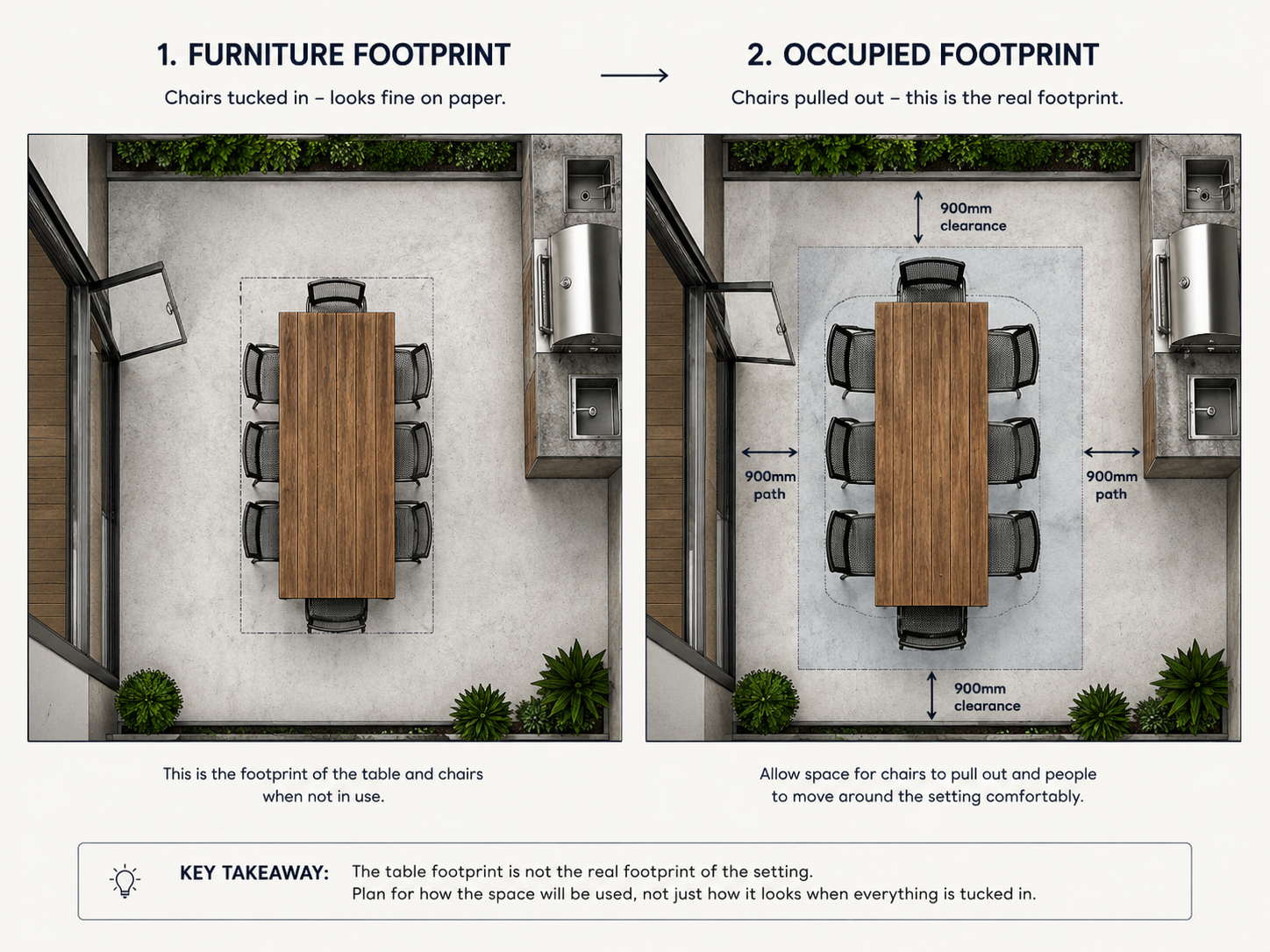
Simple way to think about it: mark out the table first, then imagine every seat occupied and somebody walking behind it. If that makes the area feel cramped before the furniture has even arrived, the setting is too large or the layout needs to change.
Choosing Outdoor Furniture Materials
Outdoor furniture material affects weight, appearance, maintenance and how the furniture feels in the space. There is no universal winner. The right material depends on where the furniture will live and what you expect it to do.
Galvanised Steel
Galvanised steel is a natural fit for heavy-duty outdoor tables and settings where a substantial frame is part of the appeal. It is common in hospitality-style furniture because the construction can be straightforward, strong and practical.
At home, that weight can be an advantage if the table is intended to stay in one place. It is less attractive if you expect to move the furniture around every weekend.
Timber
Timber brings warmth and a more natural outdoor look, which is one reason it works so well on decks, patios and garden entertaining areas. It also changes over time and requires appropriate care. Outdoor timber should be bought with realistic expectations about cleaning, exposure and maintenance rather than treated as a maintenance-free surface.
Aluminium
Aluminium is widely used in outdoor chairs and tables because it can provide a lighter alternative to heavy steel furniture. That can be particularly useful for chairs that need to move, stack or be rearranged regularly.
The exact chair still matters. Material alone does not tell you whether a piece is comfortable, stable or suitable for the way you plan to use it.
Outdoor Polypropylene and Similar Materials
Outdoor-suitable moulded chairs can be practical where easy cleaning, light weight and flexible seating matter. They are common in both home and hospitality settings because they can be easy to move around and, depending on the model, stack for storage.
As always, check the actual product rather than assuming every plastic chair is designed for the same level of outdoor use.
| Material | Why People Choose It | Good Fit For | Keep in Mind |
|---|---|---|---|
| Galvanised steel | Substantial, practical frame construction. | Heavy-duty tables, settings and furniture that stays in place. | Weight and the more industrial visual character. |
| Timber | Warm, natural outdoor appearance. | Dining tables, benches and settings. | Outdoor exposure and ongoing care. |
| Aluminium | Lighter weight and easy movement. | Chairs and furniture that is rearranged regularly. | Construction quality and stability still vary by product. |
| Outdoor polypropylene / moulded materials | Easy cleaning and light handling. | Flexible chairs and casual outdoor seating. | Check the actual product's intended outdoor use and construction. |
The best material is not the one with the longest list of marketing claims. It is the one that suits the location, the amount of use and the amount of maintenance you are realistically prepared to do.
Outdoor Chairs, Benches and Flexible Seating
The seating around the table can change how the entire outdoor area works. Individual chairs, benches and stools each solve a different problem, and there is no rule saying everything has to match.
Individual Outdoor Chairs
Individual chairs are the familiar choice for dining because every person gets a defined seat. They are also easier to move independently, which makes it simple to add or remove seating as needed.
Outdoor chairs are useful when you want to build a setting around a separate table rather than buy a complete set.
Benches
Benches work especially well with long rectangular tables and relaxed entertaining. They make efficient use of the table length and suit groups that expand and contract rather than needing a fixed chair for every person.
They are also visually simple. On a large deck or patio, two long benches can keep a substantial setting from feeling cluttered with chair backs and legs.
Stools and Bar Height
Outdoor stools are a more specialised choice. They make sense where the table itself is bar height or where the area is designed more for casual drinks and short stays than long dining sessions.
Mixing Seating Types
One of the most practical residential layouts is often a mixture: a bench along one side of a long table and individual chairs on the other side or at the ends. That can give you efficient group seating without committing every person to a bench.
| Seating | Strongest Advantage | Best For | Watch |
|---|---|---|---|
| Individual chairs | Flexibility and individual seating. | Regular dining and mixed-age groups. | They use more perimeter space when pulled out. |
| Benches | Shared capacity along a long table. | Families, groups and communal entertaining. | Access can be less convenient when the bench is full. |
| Stackable chairs | Easy changes to group size. | Homes, venues and shared spaces needing flexible capacity. | You still need somewhere sensible to store the extras. |
| Bar stools | Higher casual seating. | Drinks, bar-height tables and shorter stays. | Less universal for long family meals. |
Simple rule: choose the seating for how the table gets used. A neat matching set is not automatically better than a combination that handles your normal group more comfortably.
Planning Shade: Outdoor Umbrellas and Bases
Shade should be considered at the same time as the furniture, not after the setting is already filling the space. A good table can become uncomfortable for long periods if the afternoon sun lands directly across it, while an oversized umbrella can create its own layout problems if there is nowhere sensible to position the pole or base.
Outdoor umbrellas and umbrella bases come in different formats for different layouts. A centre-pole market umbrella suits one type of dining area, while cantilever designs move the support structure away from the centre of the table.
Table Umbrella or Cantilever?
A table umbrella is a straightforward option where the table is designed to accept a centre pole and the shade is needed over the dining area itself. A cantilever umbrella positions the support away from the centre of the table, which can be useful where you want a clearer dining surface or need the shade to approach from the side.
Think About Where the Shade Falls
Do not judge an umbrella only by canopy diameter. Think about the direction of the sun at the time you actually use the area. Morning coffee, midday lunch and late-afternoon drinks can need shade in completely different positions.
Do Not Forget the Base
The umbrella and the base are a system. The base needs to suit the umbrella, the location and the way the umbrella is being used. If you are unsure, check the specific umbrella and base requirements rather than assuming any heavy-looking base will do.
Wind and Exposure Matter
An open backyard, rooftop, exposed courtyard and sheltered deck can behave very differently in wind. Umbrellas need sensible handling and should not be treated as permanent structures that can simply be left open through changing weather.
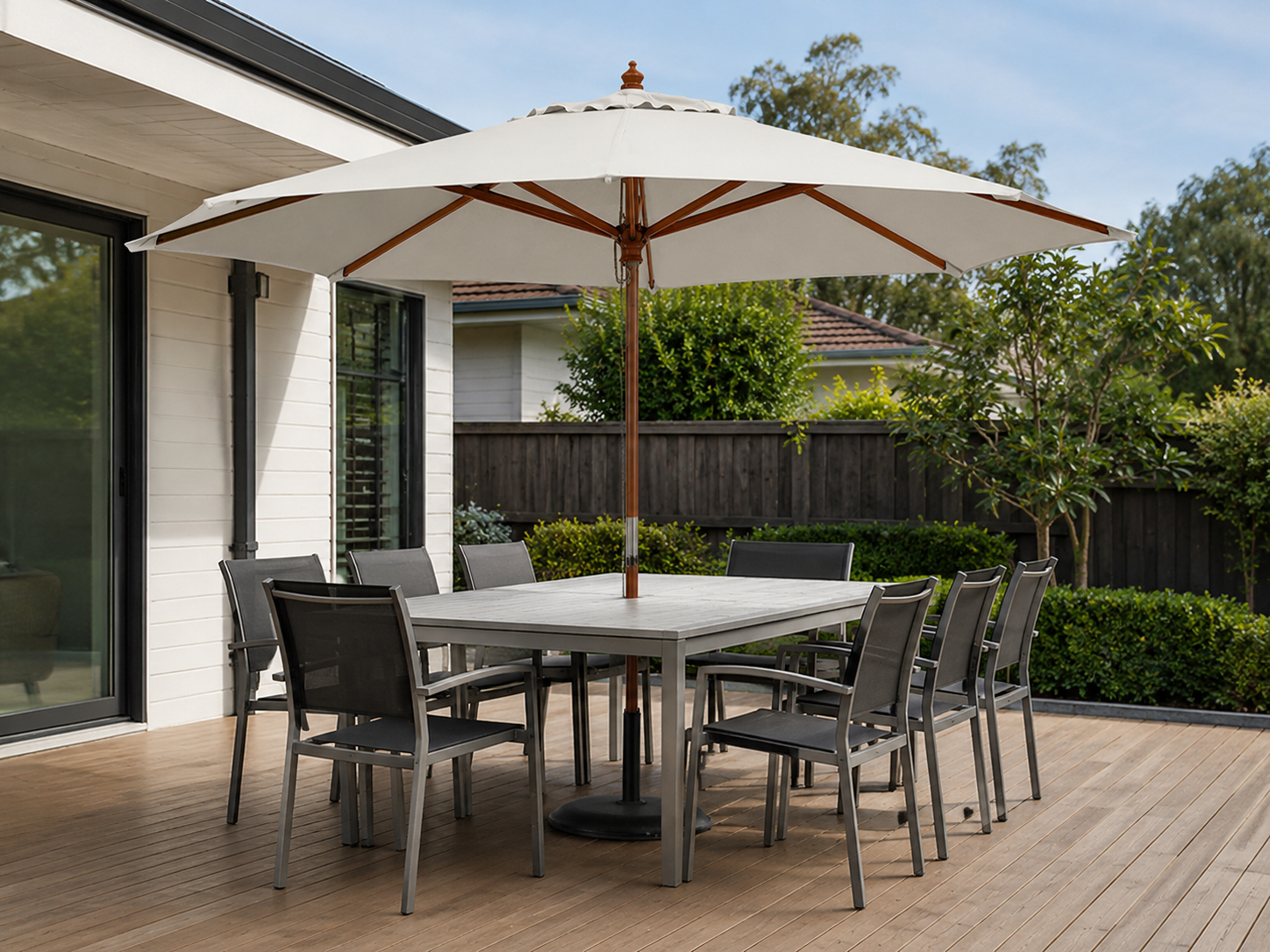
A separate outdoor umbrella guide will go deeper into size, table compatibility, cantilever versus market styles, bases and positioning. For this buying decision, the important point is simple: leave room for shade before the furniture has already claimed the whole area.
Outdoor Furniture for Melbourne Weather
Outdoor furniture in Melbourne can experience hot sun, rain, damp winter periods, leaf litter, dust and long stretches where the setting is used less often. The furniture you choose needs to make sense for where it will live all year, not just for the afternoon when you buy it.
Covered and Exposed Areas Are Different
A table under a deep verandah has a different life from a table sitting in the open. Covered areas may still receive moisture, wind-blown rain and sun from different angles, but they are not exposed in the same way as a fully open backyard.
When you are comparing furniture, describe the location accurately. “Outside” is not enough information on its own.
Cleaning Still Matters
Outdoor furniture collects dust, pollen, leaves, food, bird mess and general grime. Regular cleaning is part of keeping any outdoor setting presentable. Timber, metal and moulded seating may all need different care, so follow the product-specific instructions rather than applying one treatment to everything.
Covers and Storage
If the furniture will be unused for long periods, covers or sheltered storage may be worth considering depending on the product and location. Smaller chairs may be easy to stack or move under cover. A heavy 2400 mm table is a very different proposition, so it should be chosen with its permanent position in mind.
Practical tip
“Choose outdoor furniture for where it will live all year, not for the weather on the day you buy it.”
Common Outdoor Furniture Buying Mistakes
Most outdoor furniture mistakes are not about picking the wrong colour. They happen because the setting was chosen before the space, use and movement around it were properly considered.
Mistakes We See When Choosing Outdoor Furniture
- Buying the largest table that technically fitsThe table footprint fits, but occupied chairs and circulation do not.
- Choosing for maximum guests instead of normal useA huge table can dominate the area every day just to handle a group that visits twice a year.
- Forgetting how doors openA chair, bench or umbrella base can turn a perfectly good doorway into an obstacle course.
- Assuming benches and commercial-style tables are only for hospitalityHeavy-duty tables and bench settings can work extremely well in backyards, patios and family entertaining areas.
- Buying separate pieces without checking their proportionsTable height, chair height, arm height and overall width all need to work together.
- Planning shade after buying the furnitureThere may be no sensible location left for an umbrella or base once the setting is in position.
- Choosing material purely from appearanceWeight, maintenance, exposure and how often the furniture needs to move matter too.
- Ignoring furniture weightHeavy furniture can feel reassuring and stable, but it is the wrong choice if the setting needs to move constantly.
- Treating “outdoor” as meaning maintenance-freeOutdoor furniture still needs cleaning, sensible care and realistic treatment through changing weather.
The best way to avoid these mistakes is to start with a simple description of the area and how it gets used. Once that is clear, the size, seating format and material choices become much easier.
Browse Outdoor Furniture
Compare complete settings, separate tables, chairs and umbrellas to build the outdoor area around the space you actually have.
Frequently Asked Questions
What outdoor furniture is best for a small balcony?
A small balcony usually benefits from compact furniture that leaves the doorway and main movement path clear. A small two-person or three-piece setting can make more sense than choosing the largest table that technically fits. Measure the occupied chairs as well as the table before deciding.
How do I choose the right size outdoor setting?
Start with the usable area, then allow for seating and circulation around the setting. Think about how many people use it normally and how many you regularly entertain. The right size is the setting that works comfortably when occupied, not the largest top that fits inside the dimensions of the deck or courtyard.
How much room should I leave around an outdoor table?
Around 900 mm from the table edge is a useful starting point for chair clearance in many outdoor dining layouts. This gives chairs room to pull out and people room to sit and stand more comfortably. Where people also need to regularly walk behind occupied chairs, allowing more space will usually make the area easier to use.
Treat 900 mm as a planning rule of thumb rather than a fixed requirement. Doors, stairs, barbecues, walls and serving routes can all mean a particular layout needs more clearance.
Are benches good for outdoor dining?
Yes, especially for relaxed family dining and larger groups. Benches use the length of a table efficiently and can make it easier to seat changing group sizes. The trade-off is access: when a long bench is full, the people in the middle may need others to move.
Can beer garden furniture be used at home?
Absolutely. The name describes the style and one common use, not the only place it belongs. Timber and galvanised outdoor tables can work very well on decks, patios, barbecue areas and in backyards. Pairing a long table with individual chairs instead of benches can give it a much more residential dining character.
Are galvanised timber tables suitable for residential outdoor areas?
They can be an excellent choice where you want a substantial outdoor dining table and do not need to move it frequently. Consider the size, weight, timber care and how exposed the location is. A heavy-duty table is particularly useful in larger entertaining spaces where the furniture is intended to stay in place.
What outdoor furniture is best for Melbourne weather?
Choose for the actual level of exposure rather than Melbourne in general. A covered verandah, open deck and exposed backyard all create different conditions. Look at suitable outdoor materials, product-specific care, ease of cleaning, weight and whether covers or storage will be practical through periods of lower use.
Do I need an umbrella with an outdoor dining setting?
Not every area needs a separate umbrella, particularly if it is already well covered. In an exposed area, however, shade can make the setting far more usable. Plan the umbrella position, canopy, base and the direction of the sun before the furniture fills the available space.