

Choosing between a laundry sink vs laundry trough sounds simple until you are planning the room and trying to work out what will actually handle the mess, fit the space and still feel good to use once real life starts happening. This guide breaks down the practical difference so you can choose the setup that suits your home properly.
Some laundries only need a compact sink for hand-washing, filling buckets and the odd rinse-off job. Others need a deeper, harder-working trough that can deal with muddy runners, school uniforms, pet gear, cleaning cloths and bulky bedding without splashing everywhere.
If you want to compare while reading, you can browse our range of laundry sinks, laundry troughs and matching laundry storage & cupboards.
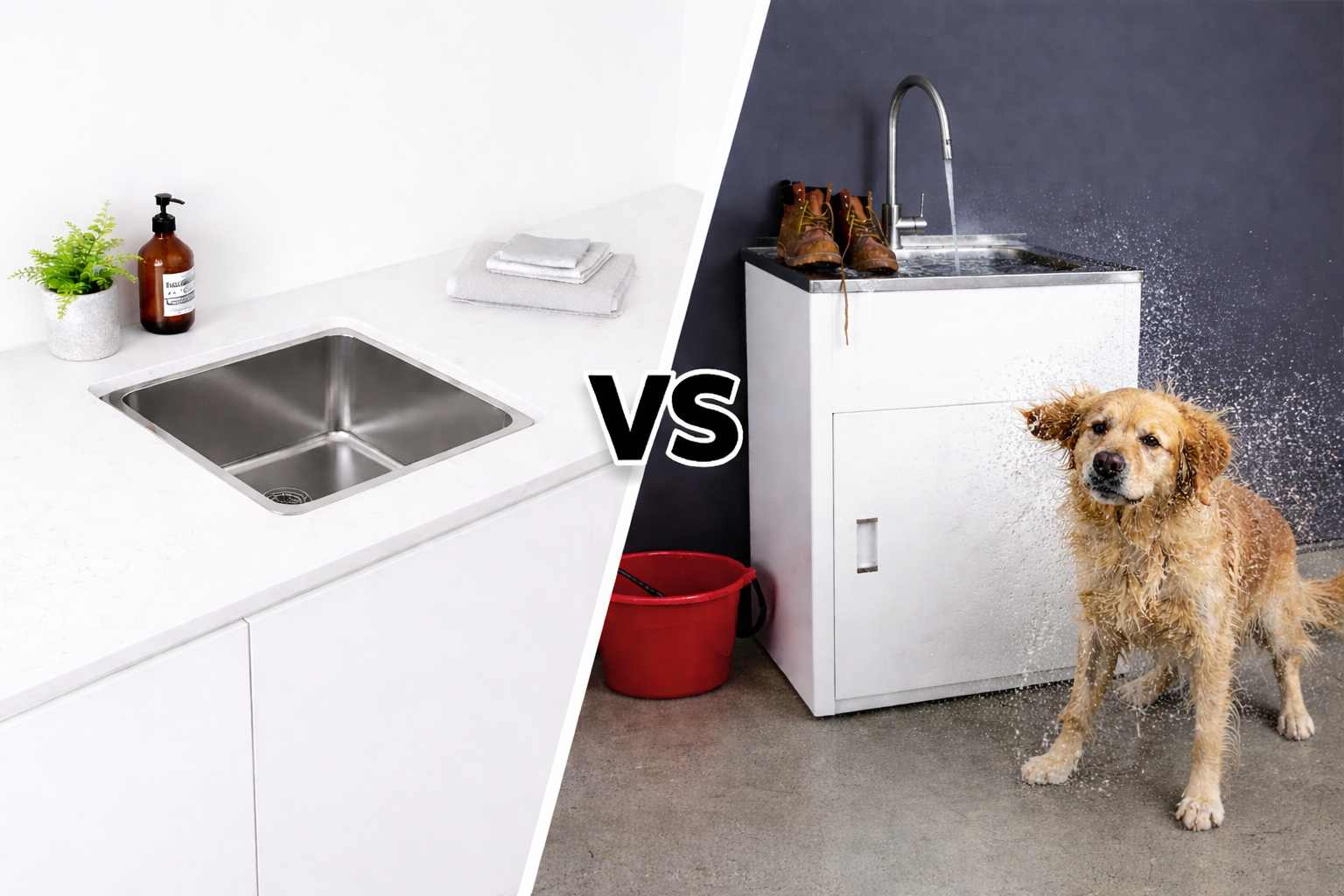
The Real Difference Between a Laundry Sink and a Laundry Trough
The short version is this:
- A laundry sink is usually the more compact, general-purpose option.
- A laundry trough is usually deeper, more utility-focused and better suited to heavier-duty cleaning jobs.
There is some overlap, but most people are really deciding between a neater everyday sink setup and a deeper utility tub that can cope with messier work.
If your laundry mainly handles light rinsing, hand-washing delicates and day-to-day household tasks, a standard laundry sink may be enough. If the room is doing proper utility duty, a trough often makes more sense.
Quick Comparison: Laundry Sink vs Laundry Trough
| Feature | Laundry sink | Laundry trough | What it means in real life |
|---|---|---|---|
| Overall feel | Compact and everyday-friendly | Utility-focused and harder-working | A sink feels neater in smaller laundries, while a trough feels more capable for serious clean-up jobs |
| Depth | Usually shallower | Usually deeper | More depth usually means less splash and easier soaking |
| Best for | Light rinsing, hand-washing, general household tasks | Muddy gear, pet items, bulky wet loads, soaking | The heavier and messier the work, the more a trough starts to make sense |
| Suitability for small laundries | Often better | Can feel oversized if space is tight | A compact room usually benefits from a more proportionate sink setup |
| Storage options | Can be paired with cabinetry | Often available as cabinet units | Many troughs come as tidy all-in-one solutions with storage underneath |
When a Laundry Sink Is Enough
A laundry sink is often the right choice when you want a practical wash-up area without the room feeling too industrial, bulky or oversized.
It usually suits households that need the laundry for:
- hand-washing delicates
- rinsing cleaning cloths
- filling mop buckets
- spot-cleaning small household items
- general everyday utility use
If your laundry is compact, built into a hallway cupboard, or doubling as a cleaner secondary utility area rather than a full mudroom-style zone, a sink can feel much more proportionate.
When a Laundry Trough Is the Better Choice
A laundry trough starts to win when the laundry has to deal with bigger, messier or wetter jobs on a regular basis.
A trough is often the smarter option if your laundry regularly handles:
- muddy footy gear
- workwear and gardening clothes
- pet bedding and bowls
- soaking stained items
- rinsing out larger cleaning gear
- washing shoes or boots
- winter bedding and bulky household laundry
The extra depth gives you more confidence for messy jobs that would feel annoying in a shallower or more compact sink.
Depth Matters More Than Most People Expect
One of the biggest mistakes people make is focusing only on overall width and forgetting how important bowl depth is in a laundry.
A deeper bowl helps with:
- reducing splash-back
- soaking larger items more easily
- cleaning awkward gear without water going everywhere
- filling buckets and tubs with less mess
If the laundry is a real work zone in your house, depth is one of the main things that separates a good setup from one that becomes annoying fast.
Match the Setup to the Way Your Laundry Actually Works
The right choice depends just as much on the room as it does on the sink itself.
For compact laundries
If space is tight, a neater laundry sink is often the smarter choice. It leaves more flexibility for a washing machine, storage and bench space.
For larger family laundries
If the room is doing more serious utility work, a laundry trough usually makes more sense. The extra depth is better for messier jobs, bulky items and anything that tends to splash.
For mudroom-style or wet-zone setups
If the laundry doubles as the clean-up point for sports gear, pet mess, gardening jobs or outdoor shoes, a trough usually feels more natural than a standard sink.
Storage, Cabinets and Complete Trough Units
Another practical difference is that many laundry troughs are designed as freestanding units rather than just a bare bowl on its own.
That often means built-in cabinet storage underneath, with one-door or two-door configurations depending on the size. If you want the laundry to feel tidier and more functional in one move, that kind of all-in-one trough unit can make a lot of sense.
It also pairs naturally with broader laundry storage & cupboards if you want the whole room to feel more finished.
Final Verdict: Which One Should You Choose?
Choose a laundry sink if you want a compact, everyday wash-up zone for lighter household tasks and you do not want the room feeling too bulky.
Choose a laundry trough if you need more depth, more splash control and a better setup for messy or heavy-duty jobs.
If you are still torn, work backwards from the dirtiest, wettest and bulkiest thing you need to clean in the laundry. That one detail usually tells you which direction to go.
More Kitchen & Laundry Sink Guides
If you are also comparing kitchen sinks, sink sizes and materials, these guides can help.
- How to Choose the Right Kitchen Sink for the Way You Actually Cook
- Single Bowl vs Double Bowl Kitchen Sinks
- Stainless Steel, Fireclay or Granite Sinks
- Kitchen Sink Sizes Explained: What Actually Fits Your Cabinet and Bench Space
Frequently Asked Questions
What is the difference between a laundry sink and a laundry trough?
A laundry sink is usually the more compact general-purpose option, while a laundry trough is usually deeper and more utility-focused. A trough is typically better for messier, wetter and heavier-duty cleaning jobs.
Do I need a laundry trough or is a sink enough?
If your laundry mainly handles light rinsing, hand-washing and day-to-day jobs, a sink may be enough. If you regularly deal with muddy shoes, pet gear, soaking and bulky wet items, a trough is often the better choice.
Are laundry troughs deeper than laundry sinks?
In many cases, yes. That extra depth is one of the main reasons people choose a trough, especially when splash control and soaking space matter.
What is a laundry trough used for?
A laundry trough is used for heavier-duty utility jobs like soaking stained clothes, rinsing muddy gear, cleaning tools, washing pet items and handling bulky wet laundry more easily.
Is a laundry sink better for a small laundry?
Often, yes. In compact laundries, a sink can feel more proportionate and leave better room for appliances, storage and bench space. The right answer still depends on what jobs the room needs to handle.
Should I get a laundry trough with a cabinet?
If you want the laundry to feel neater and more functional, a cabinet can make a big difference. It gives you storage for bottles, buckets and household cleaning products while making the whole setup feel more complete.
Can a laundry trough be used in a mudroom or garage?
Yes. Troughs are often a very practical choice in mudrooms, garages and utility zones because they are better suited to messy clean-up work than a smaller standard sink.
Need Help Choosing the Right Laundry Setup?
If you are deciding between a compact laundry sink and a deeper laundry trough, come and see us in Richmond or get in touch. We can help you narrow down the right fit for the space, the jobs you actually do, and how much storage you want built into the room.
Visit our Richmond showroom No appointment needed.