
S-trap vs P-trap vs Skew trap toilets in Australia: what it means and how to choose

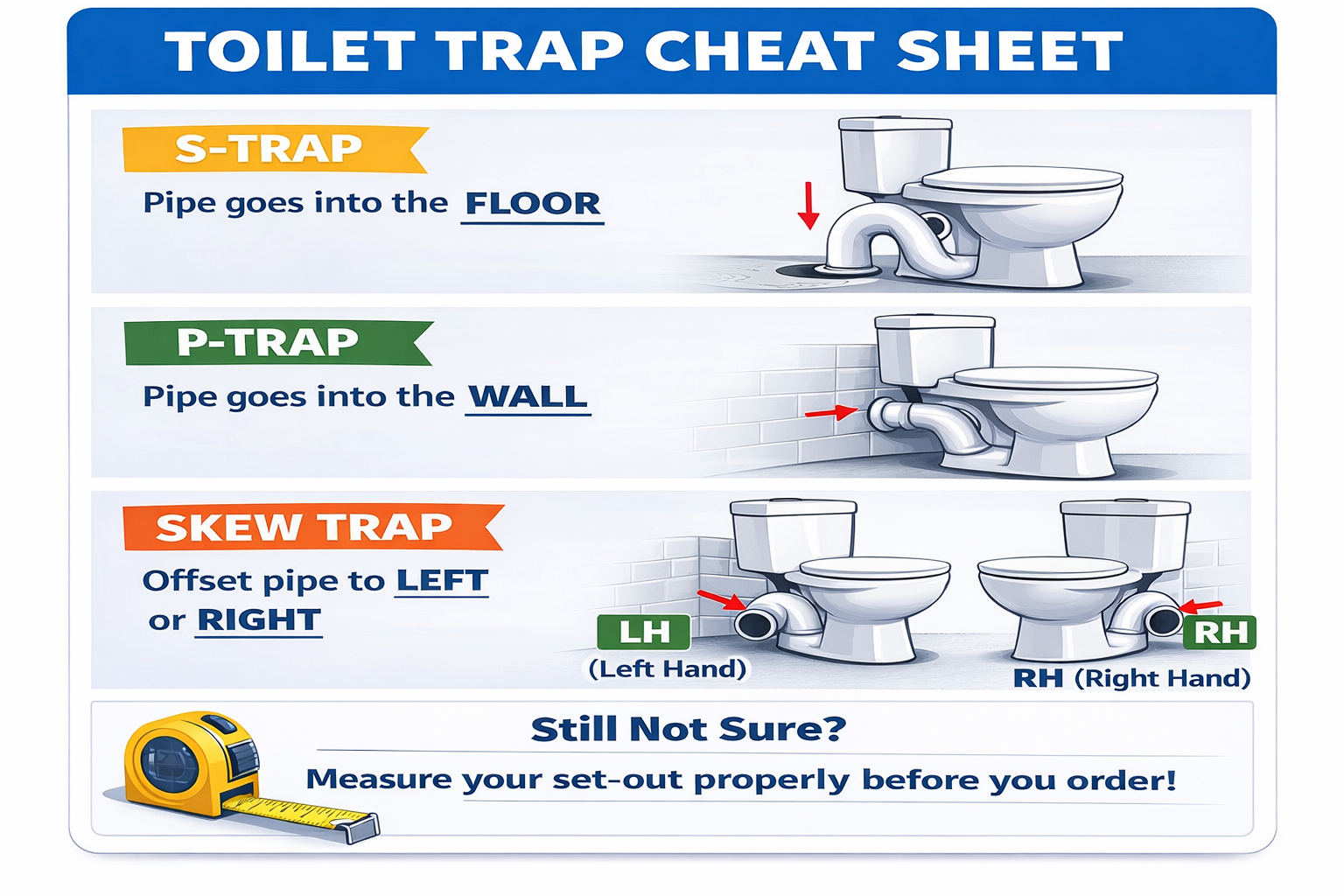
If you’re toilet shopping and you keep seeing S-trap, P-trap, skew trap or universal toilet suites, this is the bit that decides whether your new toilet will actually connect up properly. Style is fun. Plumbing fit is non-negotiable.
When you’re ready to browse, here’s the full range of toilets.
The 10-second difference
S-trap (floor outlet)
Waste outlet goes down into the floor.
Look for: the pipe disappearing into the tiles beneath the toilet.
P-trap (wall outlet)
Waste outlet goes back into the wall.
Look for: the pipe going straight into the wall behind the pan.
Skew trap (offset outlet)
Waste outlet is offset to one side.
Look for: the outlet point sitting noticeably off-centre rather than straight behind the pan.
Important: if you need a skew trap, you’ll usually need to know whether it’s left-hand (LH) or right-hand (RH) as you face the toilet.
The cheat sheet for identifying your trap
- Pipe goes into the floor = S-trap
- Pipe goes into the wall = P-trap
- Outlet is offset left or right = Skew trap (LH or RH)
Still unsure? Don’t guess. Measure properly before you order.
What is a universal trap toilet?
A lot of modern toilet suites are now universal trap or uni-trap, which means the same suite can usually be configured for either S-trap or P-trap installation.
How that works: many universal setups use a connector or Vario bend to adapt the outlet and suit the plumbing layout.
Universal does not mean fits everything. You still need to confirm the set-out, check the inlet position, and make sure the suite physically suits your bathroom.
Why identifying the trap is not enough
Knowing whether you have an S-trap, P-trap or skew trap is step one. Before ordering, you should also confirm:
- set-out
- inlet position
- left-hand or right-hand offset if skew is involved
- whether the toilet needs a specific connector or trap configuration
This is the part people skip, and it’s usually the bit that decides whether a toilet drops in neatly or turns into a frustrating return-and-reorder job.
The set-out detail people mix up
This is the most common mistake: people measure in the wrong direction.
- S-trap set-out is horizontal: measure from the finished wall to the centre of the floor waste.
- P-trap set-out is vertical: measure from the finished floor to the centre of the wall waste.
Extra important for P-traps: outlet height from the floor matters, and it can vary between brands and suites.
Always measure from finished surfaces like tiles, not raw framing or bare sheeting. In a renovation, that small difference can be enough to ruin the fit.
When you might need a skew trap
Skew trap toilets usually come up when the outlet is not centred where a standard S-trap or P-trap pan expects it to be.
This can happen when:
- you’re replacing an older toilet and the outlet was never centred
- the waste had to be routed around a joist or another site constraint
- the toilet position is a little awkward within the room
If you suspect skew, confirm whether it’s left-hand or right-hand as you face the toilet. Getting that wrong is a fast way to order the wrong suite.
Quick table: trap types at a glance
| Trap type | Outlet location | What to measure | Common use case |
|---|---|---|---|
| S-trap | Floor | Finished wall to centre of floor waste | Many standard Australian homes |
| P-trap | Wall | Finished floor to centre of wall waste | Apartments and some newer builds |
| Skew trap | Offset left or right | Confirm LH/RH offset and position | Older or awkward plumbing layouts |
Which one should you choose?
You do not choose trap type based on preference. You match what your bathroom has, unless you are changing the plumbing layout.
If you’re replacing an existing toilet
Match the current setup:
- S-trap to S-trap
- P-trap to P-trap
- Skew trap to skew trap, with the correct LH or RH side confirmed
If you’re renovating
You’ve got more flexibility, but this is the time to plan it properly.
- Decide whether the waste will run into the floor or wall
- Confirm finished wall and floor thickness
- Confirm outlet position and inlet position
- Then choose a suite that suits the planned set-out
Once you’ve confirmed the basics, browse the range of toilets.
Common mistakes before ordering
- Assuming all floor waste toilets are interchangeable
- Checking trap type but not measuring set-out
- Forgetting to confirm inlet position
- Ordering a skew trap without checking LH or RH properly
- Focusing only on the waste position and forgetting overall pan projection into the room
FAQs
How do I measure toilet set-out properly?
For an S-trap toilet, measure from the finished wall to the centre of the floor waste. For a P-trap toilet, measure from the finished floor to the centre of the wall waste. Always measure from finished surfaces such as tiles.
Do I need to check inlet position as well as trap type?
Yes. Trap type tells you where the waste goes, but it does not confirm where the water inlet sits. Before ordering, check whether your toilet needs a top inlet, bottom inlet, left-side or right-side inlet setup.
Will a universal trap toilet fit any bathroom?
No. A universal trap toilet can often be configured for either S-trap or P-trap installation, but you still need to confirm the set-out, inlet position and overall fit.
How do I know if I need a left-hand or right-hand skew trap?
If the outlet is offset rather than centred, you may need a skew trap toilet. Check which side the outlet points to as you face the toilet. If it offsets left, you need LH. If it offsets right, you need RH.
Does toilet projection matter when replacing an old suite?
Yes. Even if the trap type is correct, the new toilet can still project further into the room than your old one. That can affect clearance around doors, vanities, showers and walkways.
What are common toilet set-out sizes in Australia?
There is no one-size-fits-all answer, which is exactly why measuring matters. Many modern toilets suit common renovation ranges, but older homes and unusual plumbing layouts can vary more than people expect.
I already know I have an S-trap, P-trap or skew trap. What else should I confirm before ordering?
Confirm the set-out, the inlet position, whether the suite needs a specific connector or trap configuration, and for skew traps, whether it is left-hand or right-hand.