

If you are trying to make a built-in wardrobe more useful, the biggest question is often not whether you need an insert. It is whether that insert should be drawers or shelves.
Both can work brilliantly. Both can also be annoying if you choose the wrong one for the way you actually store things. The best option depends less on what looks neat in a product photo and more on what usually ends up in piles, tubs, baskets or on the floor in your own room.
Wardrobe inserts with drawers or shelves can both improve bedroom storage in a big way, but they solve slightly different problems. For the broader robe-upgrade angle, read our guide to built-in wardrobe storage ideas without a full renovation.
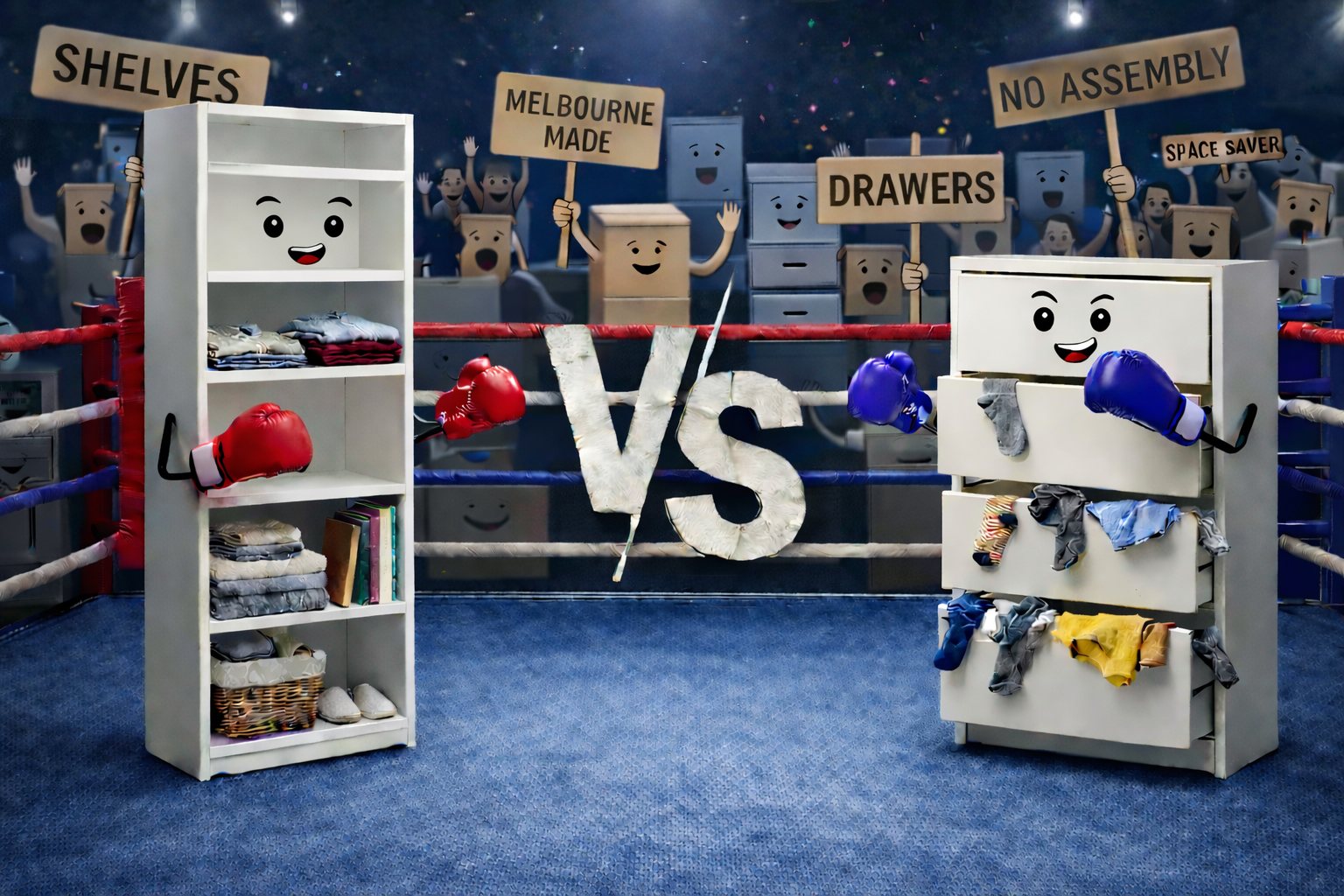
Quick Comparison: Drawers vs Shelves vs Combo Inserts
If you want the fast version, choose drawers for smaller clothing and anything you want hidden away, choose shelves for bulkier items and quick visibility, and choose a combo insert when the wardrobe needs to do both.
| Insert Type | Best For | Why It Works | Watch Out For |
|---|---|---|---|
| Drawer inserts | Underwear, socks, tees, activewear, sleepwear and kids' clothing | Keeps smaller items hidden, separated and visually tidy. | Less useful for shoes, bags, thick jumpers and bulky linen. |
| Shelf inserts | Shoes, bags, folded jumpers, jeans, towels, linen and storage tubs | Open, visible and faster to access for bulkier items. | Small everyday clothing can turn messy quickly on open shelves. |
| Drawer and shelf combo inserts | Mixed wardrobes that need both smaller clothing storage and open storage | Combines hidden containment with practical open shelf space. | You need to choose the right height and layout for your robe. |
The honest shortcut
Buy for the mess you already have, not for the fantasy version of the wardrobe you think you might keep one day. The right insert is the one that gives your real everyday clutter a proper home.
Why This Decision Matters More Than People Think
A built-in robe can have plenty of space on paper and still feel frustrating in real life. Usually that happens because the internal storage style does not match what you are actually putting in there.
If you mostly store socks, underwear, tees, activewear and smaller clothing items, shelves can turn into messy stacks pretty quickly. On the other hand, if you mostly need room for shoes, folded knitwear, towels, bags or spare linen, deep drawers may not be the most efficient use of the space.
That is why the choice between drawers and shelves is worth thinking through properly before buying.
When Drawers Are the Better Option
Drawers are usually the best pick when your wardrobe chaos comes from smaller everyday clothing.
They work particularly well for:
- underwear and socks
- T-shirts and singlets
- shorts and activewear
- sleepwear and loungewear
- kids' clothing
- accessories and smaller folded items
The big advantage of drawers is containment. They keep categories separate and hide the visual mess better than open storage. That alone can make a bedroom feel calmer.
When Shelves Are the Better Option
Shelves make more sense when you want to see things easily and grab them quickly.
They are great for:
- folded jumpers and jeans
- shoes and shoe boxes
- bags and accessories
- spare towels and linen
- baskets and storage tubs
- bulkier items that do not suit drawers
Open shelf storage can also make better use of wardrobe height, especially if you want to create several stacked zones instead of deeper closed storage.
Drawers Are Tidier, Shelves Are Faster
That is the simplest trade-off.
Drawers usually look tidier because they hide what is inside. Shelves are often faster because you can see everything at a glance. Neither is automatically better. It depends whether your biggest pain point is visual clutter or lack of quick access.
If your room feels busy and overstuffed, drawers often help more. If your wardrobe already feels organised but you need better visibility and stacking space, shelves can be the better answer.
What Usually Goes Wrong With Drawers and Shelves
What usually goes wrong with shelves
Shelves are handy, but they are not magic.
The main problem is that smaller items tend to drift. A shelf that starts with neat folded stacks can slowly turn into a mixed pile of tees, shorts, pyjamas and random extras. Once that happens, it becomes annoying to keep tidy.
That is why shelves are best for larger, more stable categories rather than lots of little daily-use items.
What usually goes wrong with drawers
Drawers are brilliant for smaller categories, but they are not always ideal for bulky storage.
If you are trying to store shoes, thick jumpers, larger handbags or linen, drawers can feel a bit limiting. You may end up wasting vertical space inside each drawer or needing more sorting than you expected.
That is where shelf inserts often win. They give bulkier items more breathing room and make them easier to access.
For Many Wardrobes, the Best Answer Is Actually Both
If your built-in robe has to deal with smaller folded clothes, shoes, bags and bulkier extras all in the one space, an all-drawer or all-shelf setup can feel a bit one-dimensional.
That is where a drawer and shelf combo insert makes a lot of sense. You get drawers for the smaller everyday items that are annoying to stack neatly, and shelves for shoes, bags, folded knitwear or anything bulkier that is easier to grab from an open section.
In this range, there are two combo sizes to suit different robe heights: a 4 drawer, 2 shelf combo at 505mm wide x 430mm deep x 1500mm high, and a 4 drawer, 3 shelf combo at 505mm wide x 430mm deep x 1800mm high.
That means you can get the same mixed-storage idea in a moderate-height insert or a taller format, depending on your robe space and how much vertical storage you want to use. If that sounds more like your storage problem, read wardrobe drawer and shelf combo inserts: the best of both worlds.
Measure Before You Decide
Before choosing any insert, measure your internal wardrobe width, depth and usable height.
Many wardrobe inserts in this style use a narrow 505mm width, which suits plenty of built-in robes, but not every robe is the same. Always check your actual internal space first, especially if there are skirtings, rails, doors or other obstructions that affect fit.
| Measurement | What to Check | Why It Matters |
|---|---|---|
| Internal width | Measure the usable space inside the robe, not just the door opening. | The insert needs to fit inside the actual storage cavity. |
| Internal depth | Check the insert depth against sliding doors, hinged doors and rear walls. | Too much depth can stop the robe operating properly. |
| Usable height | Check shelves, hanging rails and existing robe structure. | The unit needs enough vertical clearance to sit cleanly in place. |
| Access | Make sure drawers or shelves are easy to reach once installed. | Storage only works if it is comfortable to use every day. |
Pro tip
If you are torn between the two, think about what you use every day versus what you store longer term. Daily-use small items usually suit drawers. Bulkier or less fussy categories usually suit shelves.
More Robe Insert Options
If you are comparing robe inserts, these options cover hidden drawer storage, open shelves and mixed layouts.
- For hidden folded clothing storage, see the 4 drawer robe insert.
- For taller open storage, see the 5 shelf robe insert.
- For maximum shelf storage, see the 6 shelf robe insert.
- For a mix of drawers and shelves in a moderate-height format, see the 4 drawer, 2 shelf combo robe insert.
- For a taller mixed-storage option, see the 4 drawer, 3 shelf combo robe insert.
More Wardrobe Storage Ideas
If you are comparing options for a built-in robe, these guides may help:
- Are Wire Basket Wardrobe Inserts Better for Everyday Storage?
- Built-In Wardrobe Storage Ideas Without a Full Renovation
- Drawer and Shelf Combo Inserts: The Best of Both Worlds?
- Wardrobe Drawer Inserts: Adding Practical Storage to Your Bedroom
Frequently Asked Questions
Are drawers or shelves better in a built-in wardrobe?
It depends on what you need to store. Drawers are usually better for smaller clothing and anything you want hidden away. Shelves are better for shoes, folded knitwear, bags, linen and bulkier items.
Do shelves make a wardrobe look messier?
They can, especially if you use them for lots of small everyday items. Shelves work best when each section has a clear purpose and the items are easy to stack or group neatly.
Are drawers better for bedroom storage?
They are often better for everyday clothing because they help reduce visual clutter and keep categories separated more neatly.
What if I need both drawers and shelves?
A combo insert with both drawers and shelves is usually the best option when you need space for folded clothing as well as shoes, bags or bulkier bedroom items. In this range, that includes a 1500mm-high 4 drawer, 2 shelf combo and an 1800mm-high 4 drawer, 3 shelf combo, both at 505mm wide x 430mm deep. For a closer look, read wardrobe drawer and shelf combo inserts: the best of both worlds.
Should I measure my robe before choosing drawers or shelves?
Yes. Always measure the internal width, depth and height of your built-in wardrobe before choosing any insert.
Choose the Wardrobe Insert That Matches Your Storage Problem
Drawers and shelves can both improve a built-in robe, but they work best when they match what you actually store.
If your wardrobe chaos is mostly small clothing, drawers usually make sense. If it is shoes, bags, linen and bulkier items, shelves are often the better fit. If it is a bit of everything, a combo insert may save you from choosing badly.
Browse robe inserts Or visit our Richmond showroom at 365 Swan St, Richmond VIC 3121.
Family owned since 1956.